Paper: Protein source and composition influences protein digestion in infants
Objective:
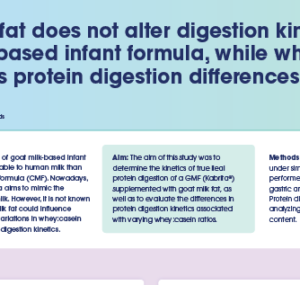
To determine protein digestion kinetics of formulas with 60:40 whey to casein ratio (Kabrita versus a cow’s milk-based infant formula [CMF]) and 60:40 to 20:80 (Kabrita versus another goat milk-based infant formula [GMF]) and to evaluate the impact of adding goat milk fat to formula on protein digestion kinetics.
Methods:
We used the Tiny-TIM digestion model to evaluate the protein digestion kinetics.
Key Findings
– Kabrita 60:40 demonstrated faster and more efficient protein digestion than cow’s milk-based infant formula with 60:40 whey to casein ratio.
– Kabrita’s whey-dominant 60:40 composition demonstrated faster and more efficient digestion in the stomach and duodenum than the GMF with a casein-dominant (20:80) composition.
– Adding goat milk fat did not alter protein digestion kinetics.
Conclusion
–Protein source matters – Protein digestion is influenced not only by nutrient levels, but also the source (i.e., goat vs cow) and structure of the protein (whey vs casein).
–Protein composition matters – Whey:casein ratio is an important design factor in infant formula and can influence protein digestion behavior.
–Kabrita’s protein design is inspired by human milk – The composition of human milk naturally evolves throughout lactation. Our Kabrita range aims to follow this compositional evolution.
Related publications
Interested to learn more about our brands and our company? Check out our other publications!